Why Western Design Rules Break in Indian Markets

Ui/Ux Design


Ui/Ux Design

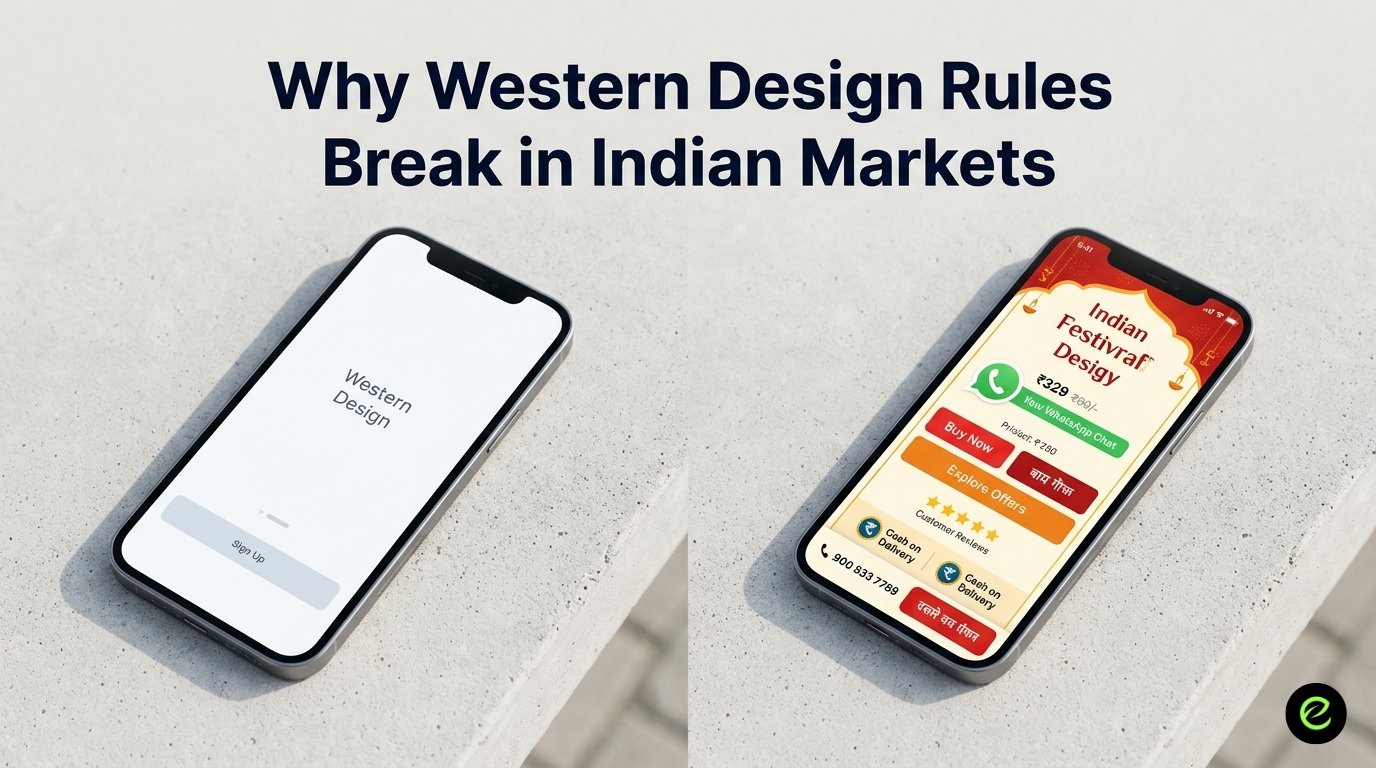
Minimal layouts, muted colors, elegant whitespace, and subtle call-to-actions have become the gold standard of Western UI/UX.
But when these same principles are applied directly to Indian markets, the results are often disappointing.
Landing pages look premium but fail to convert.
Apps feel polished but struggle with retention.
Branding appears modern yet fails to build trust.
The reason is simple: Indian user psychology, cultural symbolism, language behavior, and trust patterns are fundamentally different from Western audiences.
What feels clean and premium in the US or Europe may feel incomplete, low-trust, or emotionally disconnected in India—especially among Tier 2 and Tier 3 city users.
If your brand is targeting Bharat, understanding this difference can become your biggest competitive advantage.
Western design systems are usually built around:
minimal text
generous whitespace
single CTA flow
muted premium colors
subtle trust cues
low information density
In India, users often respond better to:
strong visual hierarchy
visible pricing and offers
WhatsApp-first communication
repeated CTAs
social proof near every action point
multilingual clarity
stronger trust signals
Indian users frequently evaluate trust, value, familiarity, and human reassurance before visual aesthetics.
That’s why a visually “beautiful” page can still underperform in India.
One of the biggest design mistakes global brands make is blindly applying Western color psychology.
In Western markets, red often signals:
danger
urgency
errors
warnings
risk
In India, red often represents:
celebration
weddings
prosperity
cultural significance
festive energy
emotional warmth
This is why red performs exceptionally well in:
saree and fashion branding
festive sales campaigns
gifting experiences
wedding service websites
real estate banners
food promotions
Yellow: positivity, rituals, spirituality
Orange/Saffron: devotion, energy, culture
Green: freshness, trust, food safety
Gold: luxury, prestige, weddings
Blue: fintech trust, professionalism
Color in India is not just visual.
It is cultural memory translated into conversion psychology.
Minimalism works in mature digital ecosystems where users are already highly trust-ready.
In India, especially outside metros, users often need more reassurance before taking action.
A page with too much empty space and too little information can create doubt.
Users may wonder:
Is this company real?
Where is the phone number?
Is WhatsApp available?
Do they offer cash on delivery?
Is there local service support?
That’s why Indian high-converting landing pages usually include:
visible phone number
WhatsApp CTA
COD badges
Google reviews
testimonials
service locations
delivery timelines
repeated CTA buttons
More context builds more confidence.
For Bharat audiences, clarity beats minimalism.
India is a multilingual-first market.
A large number of brands communicate in:
Hinglish
Benglish
Hindi-English
regional + English mixed layouts
Western typography systems built only for Latin scripts often fail here.
Recommended choices:
Inter
Poppins
Mukta
Noto Sans
Hind
Baloo 2
Indian scripts require more vertical spacing for readability.
Thin luxury fonts may look elegant on flagship devices but perform poorly on budget Android screens.
A strong India-first structure looks like this:
English headline for clarity
Hindi emotional subtext for connection
local language proof for trust
This improves:
retention
ad CTR
readability
brand recall
Western UX often follows:
one message, one CTA, one action
Indian conversion behavior often needs:
offer visibility
trust proof
WhatsApp CTA
phone CTA
testimonials
repeated CTA sections
FAQ reassurance
A better India-first hierarchy is:
Main offer
Social proof
WhatsApp CTA
Testimonials
Founder or office image
Pricing block
CTA repeat
FAQ
Contact support
This works especially well for:
real estate
institutes
healthcare
local businesses
ecommerce stores
service websites
Because Indian users are highly reassurance-driven before conversion.
The best global brands don’t simply translate.
They redesign for Indian behavior.
Uses louder campaign visuals, cricket-led storytelling, and high-energy colors aligned with Indian youth culture.
Prioritizes vegetarian navigation, family-first imagery, and India-specific menu architecture.
One of the best examples of India-first UX with:
local offers
festival banners
hyperlocal restaurant logic
multilingual experiments
payment reassurance
These brands win because they optimize for behavior, not global templates.
If your startup targets cities beyond metros, blindly copying Western SaaS or Apple-style landing pages can reduce conversions.
Instead, focus on:
stronger CTA repetition
local social proof
visible pricing
WhatsApp-first support
regional language copy
founder trust sections
human reassurance design
India-first UX is not about making interfaces crowded.
It is about designing for the emotional logic of Indian decision-making.
Western design rules are not wrong.
They are simply context-specific.
India requires a different lens—one built on culture, trust, multilingual behavior, mobile constraints, and Bharat-first psychology.
The brands that understand this will consistently outperform global-first competitors.
Because in India, the best design is not the most minimal.
It is the one that feels familiar, trustworthy, and culturally intelligent.